

The goal of the deteQUTE is designing a prototype of a superconducting single photon detector and cryogenic system.
The detector will enable implementation of quantum communication technologies, especially in the individual optical nodes of the quantum communication infrastructure.
In order to successfully complete this work package, we are combining the expertise of research groups working in the fields of low temperature (Institute of Experimental Physics of the Slovak Academy of Sciences – IEP SAS), superconducting quantum technologies (Comenius University in Bratislava – CUBA) and material engineering (Institute of Electrical Engineering of the Slovak Academy of Sciences – IEE SAS)
The deteQUTE activity, stimulates the emergence of a fully-fledged and technologically autonomous European quantum communication industry. A natural next step (beyond the present project) is to make these detector systems widely available for all euroQCI users- thus, to enter the production phase.
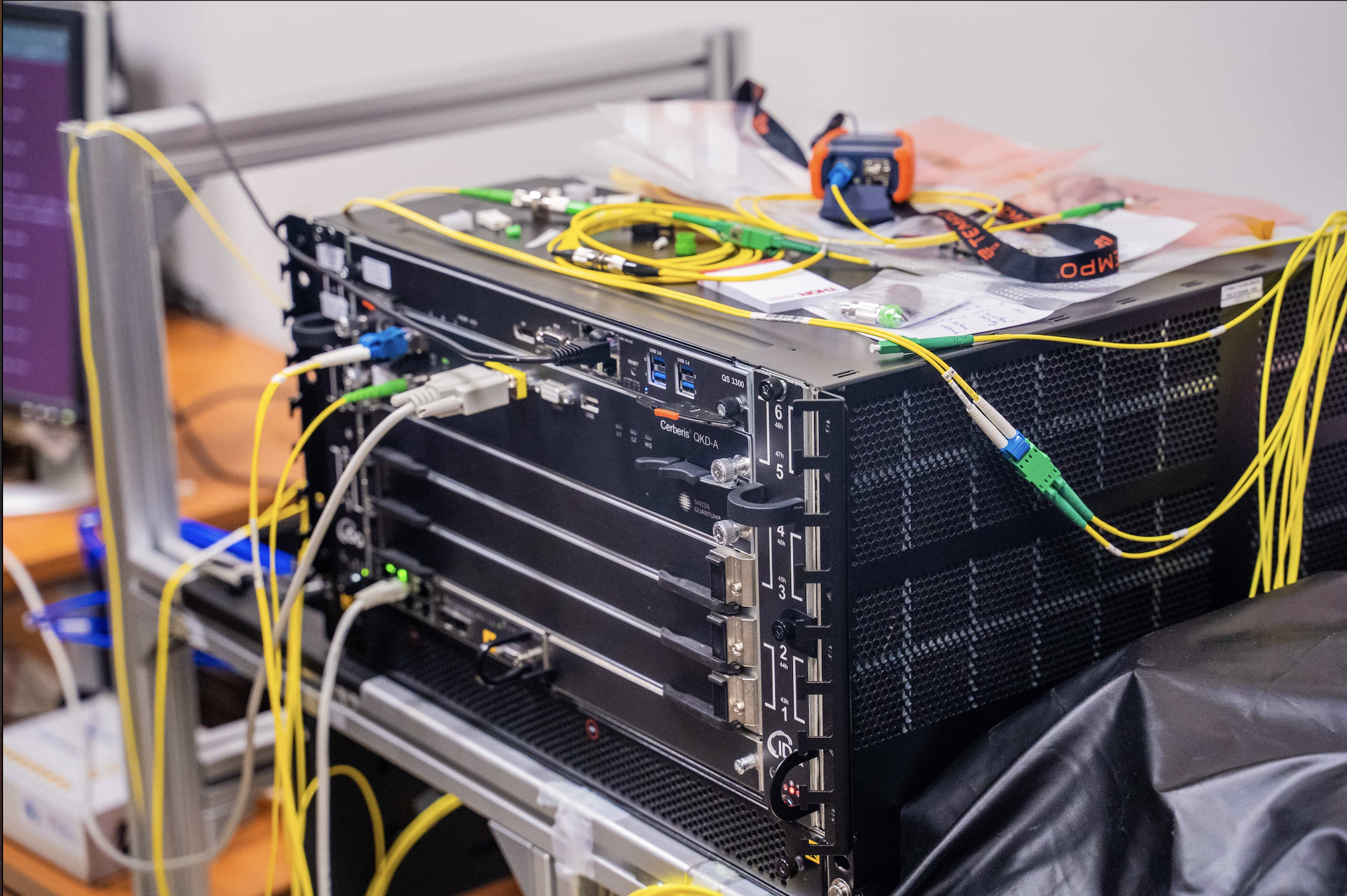
ID Quantique installation located at QUTE pavilion in Bratislava
What has been achieved?
deteQUTE (WP3) focused on developing the key hardware needed for a quantum communication node: cryogenic systems and superconducting single-photon detectors.
Two complete cryogenic systems
During the reporting period, the project team developed and constructed two complete cryogenic systems and established an in-house platform for testing and characterising superconducting single-photon detectors. The systems combine cryogenic technology, optical components, electronics and dedicated monitoring and control systems.
The systems are being commissioned and tested at the Institute of Experimental Physics of the Slovak Academy of Sciences in Košice. Initial tests have confirmed the correct operation of the refrigeration, vacuum, pumping and control systems. The in-house cryogenic platform has reached a base temperature of 2.8 K, exceeding the project’s original target.
One of the cryogenic systems developed with skQCI, validated at a base temperature of 2.8 K.
Developing our own single-photon detectors
Alongside the development of the cryogenic systems, the team worked on producing its own superconducting single-photon detectors – a key component for future quantum communication systems.
Developing these very sensitive detectors proved challenging. The team had to address problems with the thin film deposition and its parameters stabilization, challenging nanolithography and the efficient coupling of light into the detector.
Several important improvements have now been achieved. The properties of the superconducting material have been successfully tuned, and novel fiber alignment methode has been developed.
The first fabricated detectors have already demonstrated single-photon detection at 1550 nm, showing that the basic detector concept works. Further optimisation is still needed to improve their efficiency and to bring the technology closer to the performance of state-of-the-art detectors.
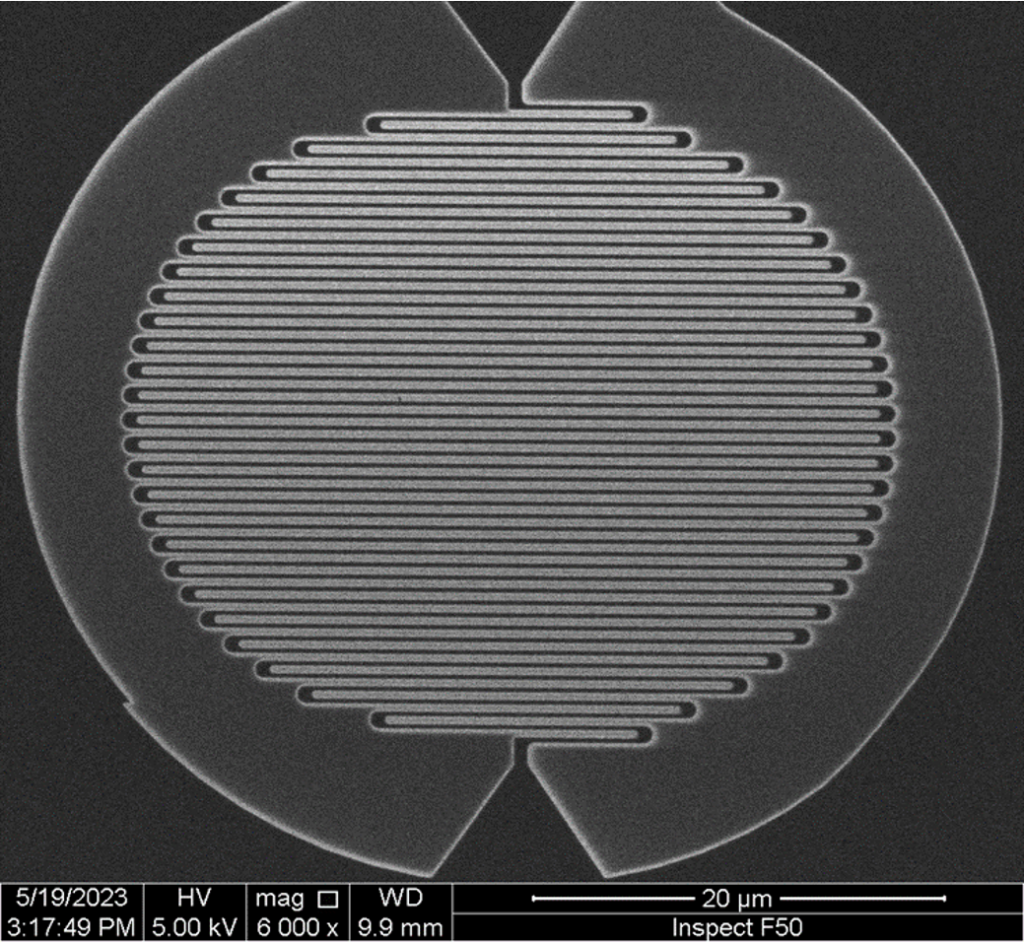


SEM image of a meander shaped NbN nanowire with 200nm width.
First results with in-house detectors
The project team successfully developed and tested the main components required for these detectors and addressed several important challenges related to their fabrication, stability and optical coupling.
The first measurements of our own detectors demonstrated single-photon detection at 1550 nm, the wavelength widely used in fiber-based quantum communication.
Moreover, novel superconducting microstrip single-photon detectors based on molybdenum carbide have been developed, demonstrating a preliminary intrinsic detection efficiency exceeding 75%.
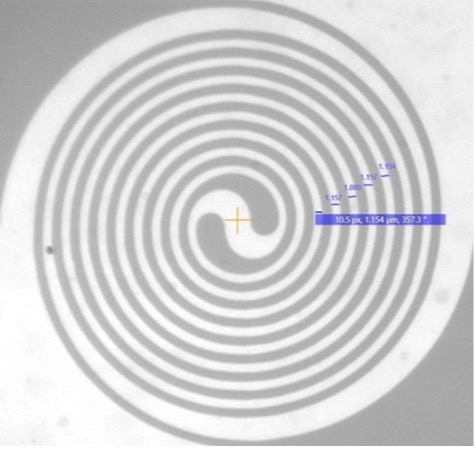
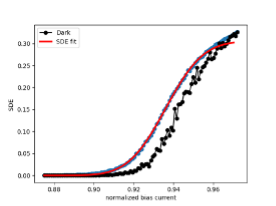
In-house superconducting microstrip single-photon detector: (a) optical micrograph of the fabricated spiral device, and (b) measured system detection efficiency and dark-count rate as a function of normalised bias current, with the fitted SDE curve.
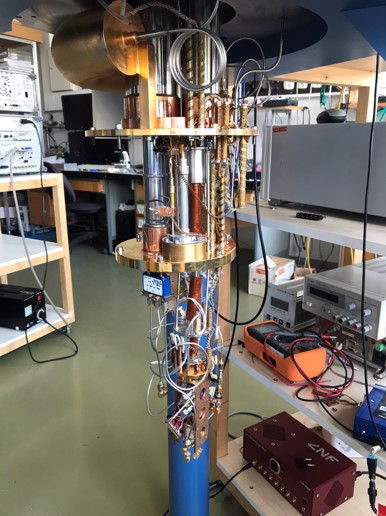
He3 sorption refrigerator with DC and microwave measurement system for characterization of superconducting nanowires.
From laboratory development to a training environment
An important additional outcome is that the project is establishing infrastructure that is used not only for research, but also for education and training.
The decision to build two cryogenic systems instead of one creates the opportunity to establish two training sites where students and researchers can work with quantum communication technologies, including photon sources, QKD equipment, optical fibres and cryogenic single-photon detectors.
The project has therefore created a new capability in Slovakia: the consortium can now develop, integrate, test and characterise superconducting single-photon detectors in-house.
Key results:
- 2 complete cryogenic systems developed
- 2.8 K lowest temperature demonstrated
- First in-house SNSPD measurements demonstrating detection
- Novel SMSPD detector with intrinsic DE >75% developed.
- New infrastructure established for quantum communication research and training
These results provide an important foundation for the further development of superconducting single-photon detectors and quantum communication technologies within the project and beyond.